
Securing contracts with the U.S. Department of Defense (U.S. DoD) starts with understanding the customer. This guide breaks down the agency’s structure, the scale of opportunities for Canadian businesses, and how public procurement works. With the right knowledge and a clear plan, you can leverage CCC to help you grow your business in this massive market.
Structure
The U.S. DoD is the largest government agency in the United States and one of the world’s biggest employers. It manages a budget of $822 billion (2022), supporting 1.3 million active duty service members and 743,000 civilian personnel spread across 4,800 sites in over 160 countries. Think of the U.S. DoD as one of the world’s largest “companies.” This scale translates into huge opportunities for contractors of all types—including Canadian businesses like yours.
Leadership
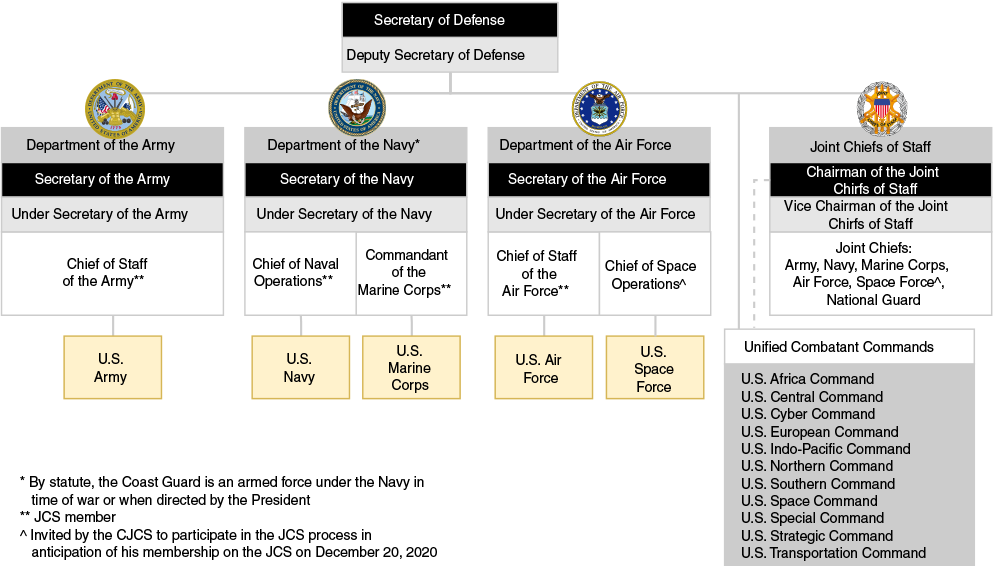
The Secretary of Defense reports directly to the President (Commander in Chief) and heads up the military and each of its branches. Along with the Department of Homeland Security, the Department of Defense is an executive department of the United States Armed Forces.
Within the U.S. DoD, there are three military departments—the Department of the Army, the Department of the Navy, and the Department of the Air Force—each of which has their own military service branches.
There are also four national intelligence agencies that report to the U.S. DoD: the Defense Intelligence Agency (DIA), the National Security Agency (NSA), the National Geospatial-Intelligence Agency (NGA), and the National Reconnaissance Office (NRO).
The U.S. DoD organizational structure also consists of a Joint Chiefs of Staff (JCS), which is a group of senior uniformed leaders who advise the Secretary of Defense, the Homeland Security Council, the National Security Council, and the President on military matters. The JCS is composed of a Chairman, Vice Chairman, Senior Enlisted Advisor to the Chairman, and the Chief of National Guard Bureau as well as Military Service Chiefs from the Army, Marine Corps, Navy, Air Force, and Space Force.
Branches of the U.S. military
The U.S. DoD controls five of the six branches of the military—Air Force, Army, Marine Corps, Navy and Space Force—with the Coast Guard reporting into the Department of Homeland Security. There are also reserve components—the Army National Guard and the Air National Guard—that operate in part under state authority. Here’s a brief description of the six U.S. military branches:
U.S. Army
The oldest service in the military, the Army, is the land service branch of the United States Armed Forces, providing ground forces to protect the United States and its global allies. It also protects U.S. installations and properties around the world. Additionally, each U.S. state has its own Army National Guard, which is in fact, a requirement of the U.S. Constitution (making it unique in this regard).
U.S. Marine Corps
The Marine Corps or U.S. Marines is the maritime land force service branch of the United States Armed Forces and is often the first branch deployed on the ground in combat. They are trained for both land and sea combat, with their own infantry, armour, artillery, aerial, and special operations forces.
U.S. Navy
The maritime services branch of the United States Armed Forces, the U.S. Navy, conducts missions primarily by sea but also by air and land. One of the biggest navies in the world, its core mission is to secure and protect the world’s oceans to foster safety for travel and trade.
U.S. Air Force
The United States Air Force (USAF) is the air service branch of the United States Armed Forces, operating planes, helicopters, and satellites. Its mission is to defend the United States in the air, space, and cyberspace. In addition, the Air National Guard acts as a separate reserve component of the USAF.
U.S. Space Force
The newest branch of the military and sister branch to the U.S. Air Force, the U.S. Space Force organizes, trains, and equips space forces with a view to protecting the interests of the U.S. and its allies in space.
U.S. Coast Guard
The United States Coast Guard (USCG) is the maritime security, search and rescue, and law enforcement service branch of the U.S. Armed Forces. USCG operates under the Department of Homeland Security, unlike the other five military branches. Both a humanitarian and a security service, the Coast Guard has jurisdiction in both domestic and international waters to conduct rescue operations, law enforcement, and drug prevention, as well as clear waterways.
Unified Combatant Commands
Lastly, the U.S. DoD has 11 Unified Combatant Commands that include units from two or more service branches of the U.S. Armed Forces. These joint military commands conduct broad and continuous missions and are organized either geographically or functionally:
- Africa Command
- Central Command
- Cyber Command
- European Command
- Indo-Pacific Command
- Northern Command
- Southern Command
- Space Command
- Special Operations Command
- Strategic Command
- Transportation Command
- Secretary of Defense
- Deputy Secretary of Defense
- Department of the Army
- Secretary of the Army
- Under Secretary of the Army
- Chief of Staff of the Army**
- U.S.Army
- Chief of Staff of the Army**
- Under Secretary of the Army
- Secretary of the Army
- Department of the Navy*
- Secretary of the Navy
- Under Secretary of the Navy
- Chief of Naval Operations**
- U.S. Navy
- Commandant of the Marine Corps**
- U.S. Marine Corps
- Chief of Naval Operations**
- Under Secretary of the Navy
- Secretary of the Navy
- Department of the Air Force
- Secretary of the Air Force
- Under Secretary of the Air Force
- Chief of Staff of the Air Force**
- U.S. Air Force
- Chief of Space Operations^
- U.S. Space Force
- Chief of Staff of the Air Force**
- Under Secretary of the Air Force
- Secretary of the Air Force
- Joint Chiefs of Staff
- Chairman of the Joint Chiefs of Staff
- Vice Chairman of the Joint Chiefs of Staff
- Joint Chiefs: Army, Navy, Marine Corps, Air Force, Space Force^, National Guard
- Vice Chairman of the Joint Chiefs of Staff
- Chairman of the Joint Chiefs of Staff
- Unified Combatant Commands
- U.S. Africa Command
- U.S. Central Command
- U.S. Cyber Command
- U.S. European Command
- U.S. Indo-Pacific Command
- U.S. Northern Command
- U.S. Southern Command
- U.S. Space Command
- U.S. Special Command
- U.S. Strategic Command
- U.S. Transportation Command
- Department of the Army
- Deputy Secretary of Defense
* By statute, the Coast Guard is an armed force under the Navy in time of war or when directed by the President
*** JCS member
^ Invited by the CJCS to participate in the JCS process in anticipation of his membership on the JCS on December 20, 2020
U.S. DoD procurement offices
U.S. DoD procurement is decentralized, with over 22 different organizations involved. While complex, understanding the basics will help you navigate the system with confidence.
Defense Logistics Agency (DLA)
U.S. procurement authority for the military is managed by the Department of Defense. The Defense Logistics Agency (DLA) manages the global supply chain—from raw materials to end user to disposition—for the Army, Navy, Air Force, Marine Corps, Space Force, Coast Guard, 11 combatant commands, other federal agencies, and partner and allied nations.
Service-Specific Procurement
From there, each individual armed service executes its own defence procurement and is supported by distinct procurement offices. In turn, each of these offices has several sub-organizations that handle specific types of procurement. Here are some of the key offices Canadian contractors should be aware of, including links to each U.S procurement website:
U.S. Army procurement – The Office of the Assistant Secretary of the Army for Acquisition, Logistics and Technology
U.S. Navy procurement – The Office of the Assistant Secretary of the Navy for Research, Development and Acquisition (including the U.S. Marine Corps)
U.S. Air Force procurement – The Office of the Assistant Secretary of the Air Force
U.S. Coast Guard procurement– United States Coast Guard Acquisition Directorate
Non-Military Opportunities
You don’t have to be a defense company to succeed in this market. Would-be contractors not directly involved in defence should also get acquainted with DLA Troop Support, the disposition service responsible for providing non-military supplies and services including food, clothing, fuel, medical supplies, construction supplies, repair parts, and more.