
This page covers the big picture of how U.S. Department of War (U.S. DoW) buys from requirements, to budgeting, to acquisition. It touches on both traditional and non-traditional procurement strategies available to U.S. DoW.
The U.S. Department of Defense uses a structured, regulated procurement process that is governed by Federal Acquisition Regulations (FARs) and Defense Federal Acquisition Regulation Supplement (DFARS). It ensures that the U.S. DoW buys products and services efficiently, competitively, and securely.
The department uses a 3-pillar framework that includes the requirements, budgetary, and acquisition processes. This page provides information about these processes.
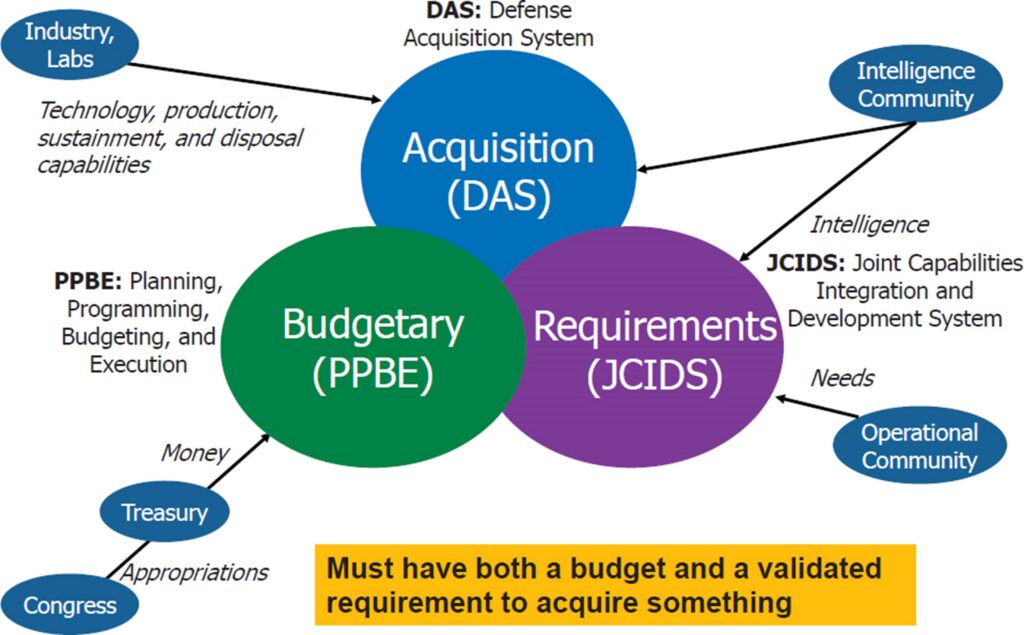
Purpose of the Image
This image explains how the Defense Acquisition System (DAS) depends on the alignment of validated requirements and approved budget resources. It visually emphasizes that the Department of Defense can only acquire something when both a requirement and funding are present.
Overall Layout and Reading Order
- The diagram is read center-focused, then outward.
- Three large, overlapping circles form the core of the diagram.
- Supporting organizations and inputs are shown around the circles with arrows pointing inward.
- A key message is displayed prominently at the bottom.
Core Components (Central Diagram)
Acquisition (DAS)
- Displayed as a large blue circle near the top center.
- Labeled “Acquisition (DAS)”, with the expanded title “Defense Acquisition System” shown above it.
- Represents the process used to develop, produce, and deploy defense capabilities.
- Receives inputs from both requirements and budgeting systems.
Budgetary (PPBE)
- Displayed as a large green circle at the lower left.
- Labeled “Budgetary (PPBE)”.
- PPBE stands for Planning, Programming, Budgeting, and Execution.
- Represents the process that allocates and manages financial resources.
Inputs to PPBE:
- An arrow from Treasury, labeled “Money.”
- An arrow from Congress, labeled “Appropriations.”
Requirements (JCIDS)
- Displayed as a large purple circle at the lower right.
- Labeled “Requirements (JCIDS)”.
- JCIDS stands for Joint Capabilities Integration and Development System.
- Represents the process that validates warfighter and operational needs.
Inputs to JCIDS:
- An arrow from the Operational Community, labeled “Needs.”
- An arrow from the Intelligence Community, labeled “Intelligence.”
Supporting Organizations and Inputs
Industry and Laboratories
- Shown on the upper left outside the circles.
- Labeled “Industry, Labs.”
- Associated text reads:
- “Technology, production, sustainment, and disposal capabilities.”
- An arrow points from Industry and Labs to Acquisition (DAS).
Intelligence Community
- Shown on the upper right.
- Labeled “Intelligence Community.”
- Provides intelligence input to Requirements (JCIDS).
Operational Community
- Shown on the lower right.
- Labeled “Operational Community.”
- Provides operational needs to Requirements (JCIDS).
Interdependencies
- The three circles—Acquisition (DAS), Budgetary (PPBE), and Requirements (JCIDS)—overlap visually.
- This overlap indicates that acquisition activities require:
- A validated requirement (from JCIDS)
- An approved budget (from PPBE)
Key Message (Highlighted Text)
- At the bottom of the diagram, a highlighted statement reads:
“Must have both a budget and a validated requirement to acquire something.”
- This sentence summarizes the central rule depicted by the diagram.
1. Requirements process
The first step of U.S DoW procurement is to define what must be purchased. The Joint Capabilities Integration and Development System (JCIDS):
- Provides the foundation for reviewing and approving capability requirements across the U.S. DoW
- Helps the Joint Requirements Oversight Council (JROC) identify and validate the military capabilities needed to carry out national defence strategies and
- Works closely with the Acquisition process and the Planning, Programming, Budget, and Execution (PPBE) process.
The JCIDS begins with a Capabilities-Based Assessment (CBA), which identifies the mission, required capabilities, gaps, and risks. This step also determines whether the solution should involve new equipment (a materiel solution) or changes to doctrine, training, or organization (a non-materiel solution).
Based on this analysis, either an Initial Capabilities Document (ICD) or a Doctrine/Organization Change Recommendation (DCR) is produced. Once the ICD is approved, the JROC validates the mission needs and gaps and decides whether to accept risk, pursue non-materiel changes, or recommend a materiel solution.
The next step is the approval of the Capability Development Document (CDD). Here, the JROC confirms key performance parameters (KPPs), evaluates cost, schedule, and technology risks, and ensures the proposed solution is affordable. Throughout the process, the JROC plays a central role by overseeing JCIDS, approving major capability documents, and validating performance requirements and priorities.
2. Budgetary process
The Planning, Programming, Budgeting, and Execution (PPBE) process is the main way the U.S. DoW allocates resources. It is an annual cycle and provides a structured approach for making decisions about policy, strategy, and the development of military forces and capabilities.
The PPBE process has four phases. The first is Planning, which sets the strategic direction. This phase begins after the National Security Strategy is issued and involves reviewing past guidance and current strategies, such as the Defense Strategy Guidance and the National Military Strategy. These documents outline national goals, military priorities, and potential threats. The Planning phase results in the Defense Planning Guidance, which shapes long-term investment plans for the next five years.
The second phase is Programming, where resources are allocated to specific roles and missions. Military departments and defence agencies translate planning decisions into detailed resource requirements, including personnel, equipment, and funding. These plans are submitted as a Program Objectives Memorandum (POM), which covers five fiscal years. This phase ensures that decisions made today are evaluated for their impact on future defense capabilities.
The third phase is Budgeting, which focuses on preparing the budget for the upcoming fiscal year. Each department submits a Budget Estimate Submission (BES) for review. The budget is analyzed and finalized before being included in the President’s Budget, which is sent to Congress by early February. The Under Secretary of Defense (Comptroller) oversees this phase to ensure the budget aligns with strategy and guidance.
Finally, the Execution phase monitors how funds are spent and evaluates whether programs meet their goals. While the acquisition process is event-driven, PPBE is calendar-driven, meaning timing is critical. Understanding this process is essential for program managers because it directly affects funding and program success.
3. Acquisition process
The Adaptive Acquisition Framework (AAF) is the U.S. DoW’s process for acquiring systems, services and technologies. It offers six acquisition pathways that allow U.S. DoW program managers to choose the method best suited to what is being acquired.
- Urgent Capability Acquisition is used for emergencies or battlefield needs that must be delivered within 2 years. It minimizes documentation and emphasizes rapid fielding.
- Middle Tier of Acquisition (MTA) is designed for rapid prototyping (<= 5 years) and rapid fielding (<= 2 years). It allows for skipping some traditional milestones to accelerate capability deployment.
- Major Capability Acquisition (MCA) is the traditional pathway for large, complex systems, like ships, aircraft, and missiles.
- Software Acquisition Pathway (SWP) is tailored for software-intensive systems that use iterative development, DevSecOps (development, security, and operations) principles and continuous updates.
- Defense Business Systems (DBS) is used to acquire or modernize business IT systems for applications like finance, HR, logistics, and health.
Acquisition of Services is designed for the procurement of services and includes performance-based requirements.
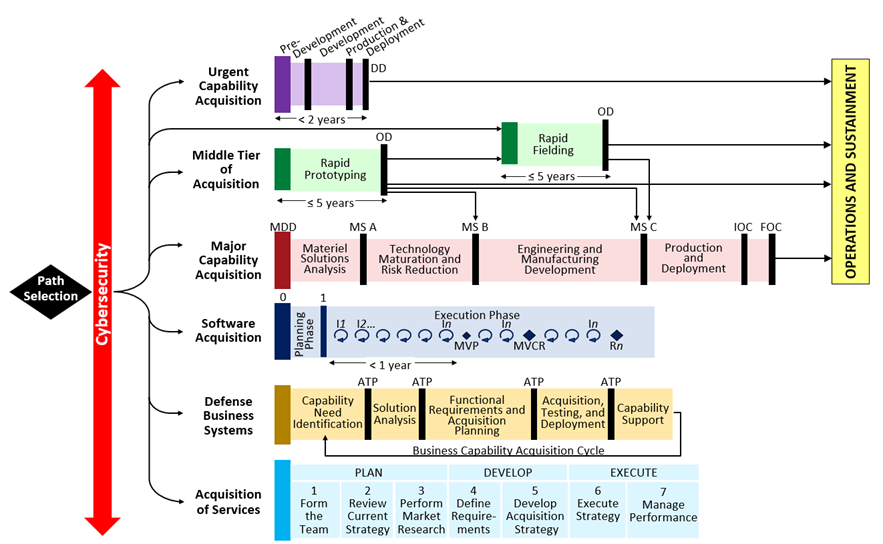
Purpose of the Image
This diagram explains the U.S. Department of Defense acquisition pathways, showing how different types of capabilities progress from initial selection to Operations and Sustainment, with cybersecurity applying across all pathways.
Overall Layout and Reading Order
- The diagram should be read from top to bottom, then left to right.
- Multiple acquisition pathways are stacked vertically.
- All pathways progress horizontally toward a shared final outcome.
- A vertical element on the far left indicates a cross-cutting concern.
Cross-Cutting Elements
Cybersecurity (Applies to All Paths)
- A vertical arrow on the far left, labeled “Cybersecurity”, spans the full height of the diagram.
- This indicates cybersecurity considerations apply to every acquisition pathway, at all stages.
Path Selection
- A label on the left reads “Path Selection”, indicating a decision point where the appropriate acquisition pathway is chosen.
Acquisition Pathways (Top to Bottom)
- Urgent Capability Acquisition
Description: This pathway supports extremely rapid delivery of urgently needed capabilities.
Stages (Left to Right):
- Development
- Development and Production
- Production and Deployment
Key Characteristics:
- Decision point labeled “DD”
- Expected timeline: less than 2 years
End State: Operations and Sustainment
- Middle Tier of Acquisition
Description:
This pathway is designed for faster delivery than traditional acquisition, without full lifecycle requirements.
Two Sub-Paths:
- Rapid Prototyping
- Focus: Demonstrate capability quickly
- Timeline: less than 5 years
- Includes an Operational Demonstration (OD) milestone
- Rapid Fielding
- Focus: Quickly field proven technologies
- Timeline: less than 5 years
- Includes an Operational Demonstration (OD) milestone
End State (Both):
Operations and Sustainment
- Major Capability Acquisition
Description:
This is the traditional, highly structured DoD acquisition pathway for large or complex systems.
Phases (Left to Right):
- Material Solution Analysis
- Milestone: MDD
- Technology Maturation and Risk Reduction
- Milestone: MS A
- Engineering and Manufacturing Development
- Milestone: MS B
- Production and Deployment
- Milestone: MS C
Operational Milestones:
- IOC: Initial Operational Capability
- FOC: Full Operational Capability
End State:
Operations and Sustainment
- Software Acquisition
Description:
A modern, iterative approach tailored specifically for software development.
Structure:
- Begins with Planning
- Followed by an Execution Phase
Execution Characteristics:
- Multiple short, repeating development cycles
- Includes labels such as:
- MVP (Minimum Viable Product)
- MCR
- Iterative increments marked “R” and “In”
Timeline:
- Typical cycle: less than 1 year
End State:
Operations and Sustainment
- Defense Business Systems
Description:
Structured approach for acquiring and managing business IT systems.
Business Capability Acquisition Cycle
Phases:
- Capability Need Identification
- Solution Analysis
- Functional Requirements and Acquisition Planning
- Acquisition, Testing, and Deployment
- Capability Support
Lifecycle Grouping:
- Plan
- Develop
- Execute
Governance Checkpoints:
- Multiple milestones labeled ATP (Authority to Proceed) appear between phases.
- Acquisition of Services
Description:
A distinct process for acquiring services rather than physical systems.
Seven Sequential Steps:
- Form the Team
- Review Current Market
- Perform Market Research
- Define Requirements
- Develop Acquisition Strategy
- Execute Strategy
- Manage Performance
Final Outcome for All Pathways
Operations and Sustainment
- Displayed as a single vertical block on the far right
- Represents ongoing operation, maintenance, and support
- All acquisition pathways converge here
Solicitation
Once a pathway is selected, the buying program office refines the needed capabilities into contract-ready requirements and issues a formal solicitation.
Solicitations formally announce the government’s needs to industry, define the evaluation criteria and establish the terms under which companies may compete. They will include the technical requirements, performance objectives, expected deliverables, contract types, schedule expectations, data rights, compliance obligations, and price structure. The U.S. DoW uses the following solicitation notices:
- Request for Information (RFI)
- Sources Sought
- Request for Quote (RFQ)
- Invitation for Bid (IFB)
- Request for Proposal (RFP)
- Broad Agency Announcement (BAA)
- Commercial Solutions Opening (CSO)
- Other Transaction Authority (OTA) Solicitations
- Request for White Papers (RWP)
- Combined Synopsis/Solicitation
Learn more about U.S. DoW solicitation notices
Source selection
During this stage, government buyers evaluate proposals to determine which offer best meets the U.S. DoW’s needs. Depending on the acquisition strategy, the U.S. DoW may use methods such as Lowest Price Technically Acceptable (LPTA), Best Value Tradeoff, or sole-source procurement.
After evaluation and any necessary negotiations, the government awards the contract.
Contract administration
Once awarded, a U.S. contracting officer or CCC (for contracts with Canadian companies), monitor contractor performance to ensure all contract requirements are met. They track schedule and cost progress, verify quality, review deliverables, handle invoicing, and manage any contract modifications.
The primary officials involved may include the Contracting Officer (CO or KO for U.S. DoW), who awards the contract, or an Administrative Contracting Officer (ACO), who manages ongoing administration. For complex contracts, contractors may also interact frequently with Contracting Officer Representatives (CORs) or Technical Representatives (COTRs), who monitor performance but cannot change contract terms.
Additional U.S. government personnel, such as quality assurance representatives or property administrators, may participate depending on the contract’s scope. Contractors are advised to keep thorough records of communication in case disputes arise.
For most U.S. DoW contracts involving Canadian products or services, CCC administers the agreement in coordination with the Defense Contract Management Agency. Canadian firms that do not use CCC must manage their own contract administration and comply with the extensive requirements.
Contract closeout
When all work has been completed, government personnel verify that deliverables have been accepted and all payments have been processed. Contract files are reviewed and audited to ensure compliance, and any outstanding administrative actions are completed. Finally, the contract is formally closed.
Considerations during the life of the contract
During the life of a U.S. government contract, several considerations affect how the contract is managed.
The government can unilaterally change specifications or service descriptions for non-commercial items, with contractors entitled to negotiate equitable adjustments in cost or schedule. Commercial item contracts, however, require mutual agreement for changes.
Inspection and acceptance requirements vary by contract; the government may rely on a contractor’s quality system or inspect directly, sometimes at any time or place. Contractors may also be required to meet international quality standards.
Disputes with the contracting officer may arise over specifications or equitable adjustments, and contractors have the right to appeal to a Board of Contract Appeals or the U.S. Court of Federal Claims. Agencies also offer alternative dispute resolution methods to avoid lengthy litigation. Canadian companies contracting with the U.S. DoW through CCC can work with CCC experts to resolve disputes.
The U.S. government may audit contract costs, particularly for large modifications or negotiated contracts, though commercial items are generally exempt from these audit rights. Agencies working with Canadian companies contracted through CCC will alert CCC that they need a Public Services and Procurement Canada to do an audit.
Contractors must maintain records related to government property, patents, or reporting requirements, especially for complex contracts.
U.S. contracts include termination clauses. A Termination for Convenience allows the government to end the contract without contractor fault, with reimbursement for reasonable costs but not anticipated profits. Termination for Default applies when contractors fail to meet requirements, potentially limiting recovery and exposing them to reprocurement costs, though default terminations can sometimes be appealed and converted to convenience terminations.
The U.S. government tracks contractor performance in centralized systems, and these records influence eligibility and evaluation in future contract awards. Maintaining good communication and resolving issues early is essential to protecting performance ratings and future contracting opportunities.
Non-traditional procurement process
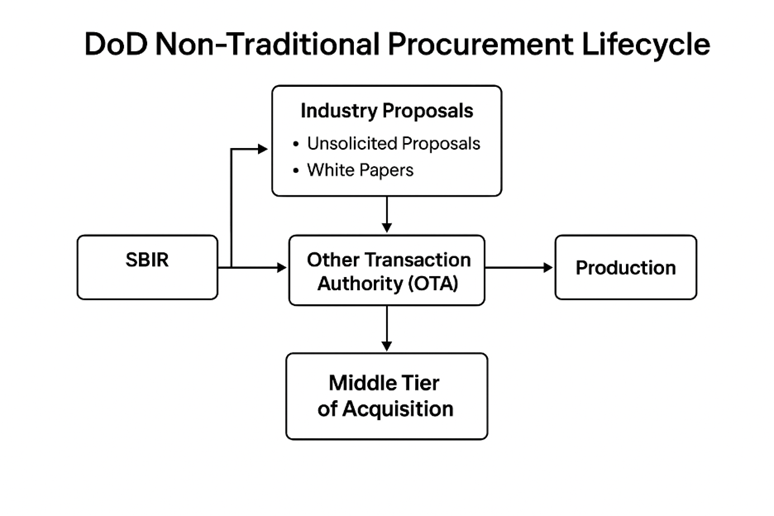
Here’s the visual showing the U.S. DoW Non-Traditional Procurement Lifecycle:
- Small Business Innovation Research (SBIR) and Industry Proposals (white papers, unsolicited proposals) feed into Other Transaction Authority agreements (OTAs).
- OTAs serve as the flexible contracting tool for prototypes and can lead to full Production.
- Middle Tier of Acquisition (MTA) is shown as a pathway that often leverages OTA for rapid prototyping and fielding.
Relationship Between MTA and OTA
- Middle Tier Acquisition (MTA) is an acquisition pathway that allows rapid prototyping and rapid fielding without traditional milestones.
- OTAs are a contracting tool that can be used under various acquisition pathways—including MTA—to execute agreements for prototypes and follow-on production.
How They Work Together
- When a program is approved under MTA, the program manager can choose how to contract for the work:
- OTA agreements (common for prototypes and non-traditional vendors).
- FAR/DFARS-based contracts (traditional approach).
- Hybrid approaches (mix of OTA and FAR/DFARS).