
Securing contracts with the U.S. Department of War (U.S. DoW) starts with understanding the customer. This guide breaks down the agency’s structure, the scale of opportunities for Canadian businesses, and how public procurement works. With the right knowledge and a clear plan, you can leverage CCC to help you grow your business in this massive market.
The Adaptive Acquisition Framework (AAF) is the U.S. DoW’s process for acquiring systems, services and technologies. It offers six acquisition pathways that allow U.S. DoW program managers to choose the method best suited to what is being acquired.
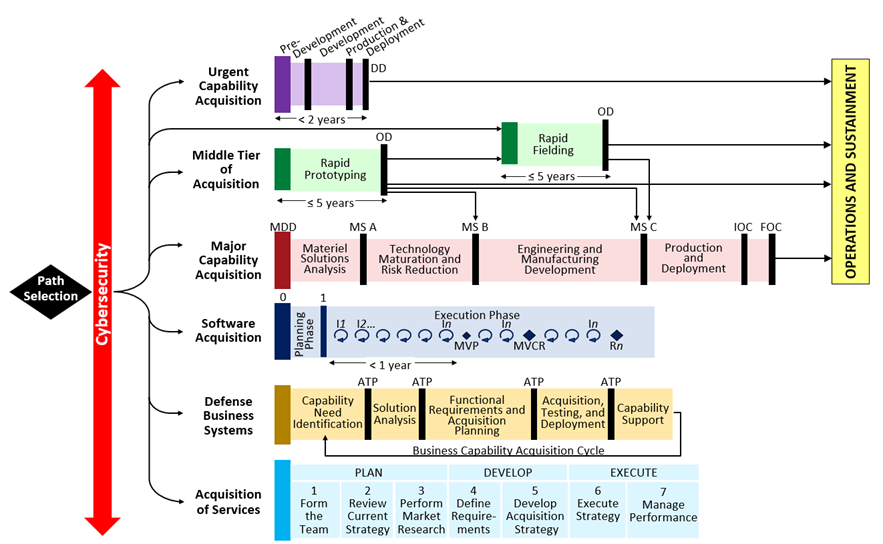
Purpose of the Image
This diagram explains the U.S. Department of War acquisition pathways, showing how different types of capabilities progress from initial selection to Operations and Sustainment, with cybersecurity applying across all pathways.
Overall Layout and Reading Order
- The diagram should be read from top to bottom, then left to right.
- Multiple acquisition pathways are stacked vertically.
- All pathways progress horizontally toward a shared final outcome.
- A vertical element on the far left indicates a cross-cutting concern.
Cross-Cutting Elements
Cybersecurity (Applies to All Paths)
- A vertical arrow on the far left, labeled “Cybersecurity”, spans the full height of the diagram.
- This indicates cybersecurity considerations apply to every acquisition pathway, at all stages.
Path Selection
- A label on the left reads “Path Selection”, indicating a decision point where the appropriate acquisition pathway is chosen.
Acquisition Pathways (Top to Bottom)
- Urgent Capability Acquisition
Description: This pathway supports extremely rapid delivery of urgently needed capabilities.
Stages (Left to Right):
- Development
- Development and Production
- Production and Deployment
Key Characteristics:
- Decision point labeled “DD”
- Expected timeline: less than 2 years
End State: Operations and Sustainment
- Middle Tier of Acquisition
Description:
This pathway is designed for faster delivery than traditional acquisition, without full lifecycle requirements.
Two Sub-Paths:
- Rapid Prototyping
- Focus: Demonstrate capability quickly
- Timeline: less than 5 years
- Includes an Operational Demonstration (OD) milestone
- Rapid Fielding
- Focus: Quickly field proven technologies
- Timeline: less than 5 years
- Includes an Operational Demonstration (OD) milestone
End State (Both):
Operations and Sustainment
- Major Capability Acquisition
Description:
This is the traditional, highly structured DoW acquisition pathway for large or complex systems.
Phases (Left to Right):
- Material Solution Analysis
- Milestone: MDD
- Technology Maturation and Risk Reduction
- Milestone: MS A
- Engineering and Manufacturing Development
- Milestone: MS B
- Production and Deployment
- Milestone: MS C
Operational Milestones:
- IOC: Initial Operational Capability
- FOC: Full Operational Capability
End State:
Operations and Sustainment
- Software Acquisition
Description:
A modern, iterative approach tailored specifically for software development.
Structure:
- Begins with Planning
- Followed by an Execution Phase
Execution Characteristics:
- Multiple short, repeating development cycles
- Includes labels such as:
- MVP (Minimum Viable Product)
- MCR
- Iterative increments marked “R” and “In”
Timeline:
- Typical cycle: less than 1 year
End State:
Operations and Sustainment
- Defense Business Systems
Description:
Structured approach for acquiring and managing business IT systems.
Business Capability Acquisition Cycle
Phases:
- Capability Need Identification
- Solution Analysis
- Functional Requirements and Acquisition Planning
- Acquisition, Testing, and Deployment
- Capability Support
Lifecycle Grouping:
- Plan
- Develop
- Execute
Governance Checkpoints:
- Multiple milestones labeled ATP (Authority to Proceed) appear between phases.
- Acquisition of Services
Description:
A distinct process for acquiring services rather than physical systems.
Seven Sequential Steps:
- Form the Team
- Review Current Market
- Perform Market Research
- Define Requirements
- Develop Acquisition Strategy
- Execute Strategy
- Manage Performance
Final Outcome for All Pathways
Operations and Sustainment
- Displayed as a single vertical block on the far right
- Represents ongoing operation, maintenance, and support
- All acquisition pathways converge here
Urgent capability acquisition
Urgent Capability Acquisition (UCA) is a high priority, fast-track pathway to deliver operational capabilities in under two years to meet urgent or emerging warfighter needs. The focus is on speed without waiting for a fully mature system.

Purpose of the Image
This image illustrates the Urgent Capability Acquisition pathway within the U.S. Department of War acquisition framework, showing how an urgent capability progresses from development to long-term operations.
Overall Layout and Reading Order
- The diagram is read left to right.
- It contains a single acquisition pathway.
- The pathway begins on the left with development activities and ends on the right with long-term sustainment.
Acquisition Pathway Description
Urgent Capability Acquisition
Description:
This pathway is intended for rapid delivery of urgently needed capabilities, bypassing longer traditional acquisition timelines.
Stages (Left to Right):
- Development
- Development and Production
- Production and Deployment
Milestone Indicator:
- A vertical marker labeled “DD” appears after Development and before full Production and Deployment, representing a formal decision or transition point.
Timeline Indicator:
- A horizontal annotation beneath the early stages states “less than 2 years”, indicating accelerated delivery from development through deployment.
Final Outcome
Operations and Sustainment
- On the far right of the diagram is a vertical block labeled “Operations and Sustainment.”
- This represents ongoing operation, maintenance, and support after deployment.
- The Urgent Capability Acquisition pathway connects directly into this stage.
Three types of urgent capability acquisitions
A Joint Urgent Operational Need (JUON) is identified by a combatant commander, and the scope is limited to addressing urgent operational needs for ongoing operations affecting multiple U.S. DoW components.
A Joint Emergent Operational Need (JEON) addresses a capability gap in an anticipated or pending contingency operation affecting multiple U.S. DoW components.
An Urgent Operational Need (UON) is a capability requirement identified by a single U.S. U.S. DoW component.
These types of acquisitions don’t involve the development of new technology or capability. However, they might accelerate an advanced technology demonstration or include a minor modification to an existing system.
Urgent capability acquisitions process
Pre‑Development Phase
- Begins when U.S. DoW receives a validated urgent operational need.
- Component Acquisition Executive appoints:
- Program Manager (PM)
- Milestone Decision Authority (MDA)
- PM works with users/requirements authorities to:
- Confirm required capability
- Establish minimum performance standards
- Analyze solution options (domestic/foreign, existing/new)
- Assess cost, schedule, performance, and operational risk
- Document safety and supportability risks
- PM recommends a preferred solution to the MDA for approval.
Development Phase
- Evaluates capability for:
- Performance, safety, suitability, survivability, supportability (incl. software)
- Lethality, if applicable
- Not all issues must be fixed before production.
- MDA, with users/requirements authorities, determines:
- Which issues must be resolved
- Which risks can be accepted
Production & Deployment Phase
- Begins when MDA approves:
- Capability readiness for production/deployment
- Updated acquisition strategy and sustainment plan
- Organization delivers to warfighters:
- Capability system
- Training, spare parts, technical data (incl. hazards), software, facilities, logistics support
- Components ensure rapid delivery and verify quantities (including training/support assets).
Operations & Support Phase
- Ensures capability is safely and cost‑effectively sustained throughout its lifecycle.
- Conducts a post‑deployment assessment to evaluate performance and gather user feedback.
Disposition (Within One Year of Deployment)
- U.S. DoW conducts a disposition analysis to decide whether to:
- Terminate the capability
- Continue sustaining it for current operations
- Transition it into a formal Program of Record
- Decision considers performance, safety, operational needs, and future plans.
- Final decision is documented and coordinated with senior leadership and authorities.
Download PDF of the urgent capability acquisition process
Middle Tier of Acquisition
Middle Tier of Acquisition (MTA) is designed for rapid prototyping (<= 5 years) and rapid fielding (<= 2 years). It allows for skipping some traditional milestones to accelerate capability deployment. Within the MTA pathway, there are two distinct approaches: rapid prototyping and rapid fielding.
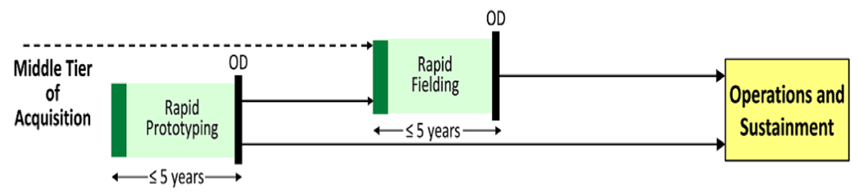
Purpose of the Image
This image illustrates the Middle Tier of Acquisition pathway within the U.S. Department of War acquisition framework. It shows two accelerated approaches—Rapid Prototyping and Rapid Fielding—and how they lead to Operations and Sustainment.
Overall Layout and Reading Order
- The diagram is read left to right.
- It presents one acquisition pathway with two related stages.
- Both stages are connected sequentially and converge on a common end state.
Acquisition Pathway Description
Middle Tier of Acquisition
Description:
The Middle Tier of Acquisition is designed to deliver capabilities faster than traditional acquisition, while maintaining structured decision points.
Stage 1: Rapid Prototyping
- Located on the left side of the diagram.
- Labeled “Rapid Prototyping.”
- Purpose: Quickly develop and demonstrate a capability.
- Includes a vertical milestone marker labeled “OD” (Operational Demonstration).
- Timeline annotation beneath this stage reads “less than 5 years.”
- The output feeds directly into the next stage.
Stage 2: Rapid Fielding
- Located to the right of Rapid Prototyping.
- Labeled “Rapid Fielding.”
- Purpose: Rapidly field proven capabilities.
- Includes a vertical milestone marker labeled “OD” (Operational Demonstration).
- Timeline annotation beneath this stage also reads “less than 5 years.”
MTA Process: Rapid prototyping and rapid fielding
Rapid prototyping focuses on using innovative technology to quickly develop and demonstrate fieldable prototypes of new capabilities, typically in operationally relevant environments. A successful rapid prototyping effort produces a prototype that meets military needs and provides a residual operational capability within five years of the program’s start.
Rapid fielding uses proven technologies or minimally developed systems with the objective of beginning production quickly (often within six months of approval) and completing fielding within five years.
Both strands are intended to deliver real capability faster and with a leaner documentation burden compared with traditional acquisition pathways.
Major Capability Acquisition
Major Capability Acquisition (MCA) is the main acquisition pathway for large and complex defense systems—such as aircraft, ships, and major weapons.

Purpose of the Image
This image depicts the Major Capability Acquisition pathway within the U.S. Department of War acquisition framework. It shows a structured, sequential set of phases used to acquire large, complex, or high-risk defense capabilities, from initial analysis through deployment and long-term sustainment.
Overall Layout and Reading Order
- The diagram is read left to right.
- It contains one linear acquisition pathway.
- The pathway progresses through clearly defined phases separated by decision milestones.
- The pathway ends in a shared sustainment stage.
Acquisition Pathway Description
Major Capability Acquisition
Description:
This is the traditional, highly governed acquisition pathway with formal milestones and decision points.
Phase 1: Material Solution Analysis
- Located at the far left.
- Labeled “Material Solution Analysis.”
- Associated milestone: MDD (Materiel Development Decision).
- Purpose: Assess potential solutions to address a validated capability need.
Phase 2: Technology Maturation and Risk Reduction
- Positioned to the right of Material Solution Analysis.
- Labeled “Technology Maturation and Risk Reduction.”
- Associated milestone: MS A.
- Purpose: Reduce technical risk and mature key technologies before full system development.
Phase 3: Engineering and Manufacturing Development
- Located after Technology Maturation and Risk Reduction.
- Labeled “Engineering and Manufacturing Development.”
- Associated milestone: MS B.
- Purpose: Complete system design and prepare for production.
Phase 4: Production and Deployment
- Positioned to the right of Engineering and Manufacturing Development.
- Labeled “Production and Deployment.”
- Associated milestone: MS C.
- Purpose: Manufacture the system and deploy it to users.
Operational Milestones
- After Production and Deployment, two vertical milestone markers appear:
- IOC: Initial Operational Capability
- FOC: Full Operational Capability
- These indicate increasing levels of system availability and maturity in operational use.
Final Outcome
Operations and Sustainment
- Located at the far right of the diagram.
- Displayed as a vertical box labeled “Operations and Sustainment.”
- Represents ongoing operation, maintenance, upgrades, and support over the system’s lifecycle.
- The Major Capability Acquisition pathway transitions directly into this stage.
Source: DAU.com
Major capability acquisition process
Materiel Development Decision
- Entry point into the MCA pathway.
- Establishes rationale for pursuing a materiel solution.
- Sets the foundation for subsequent planning and decision points.
Milestone A
- Authorizes entry into Technology Maturation & Risk Reduction (TMRR).
- Confirms the preferred solution is affordable and technically feasible.
- Ensures a coherent acquisition strategy is developed.
- Results in:
- Release of final TMRR contract solicitations
- Establishment of the program acquisition strategy
Milestone B
- Authorizes entry into Engineering & Manufacturing Development (EMD).
- Based on reduced risks and validated design/plan executability from TMRR.
- Commits investment resources for EMD.
- Establishes the Acquisition Program Baseline (APB).
- Typically includes release of the development RFP and planning for Low-Rate Initial Production (LRIP).
Milestone C
- Authorizes transition into Production & Deployment (P&D).
- Allows LRIP or limited deployment (for AIS programs).
- Full-rate production or full deployment decisions follow when the system is ready.
Production & Deployment
- System is built, tested, and fielded to operational units.
- LRIP, training, and deployment activities occur as planned.
Operations & Support
- Begins once the system is fielded.
- Focuses on sustainment, maintenance, and long-term support.
- Ensures readiness, affordability, and supportability across the lifecycle.
Software Acquisition Pathway
The Software Acquisition Pathway (SWP) is tailored for software-intensive systems. It emphasizes Agile, DevSecOps (Development, Security, Operations), Lean practices, and close collaboration between government and industry teams.
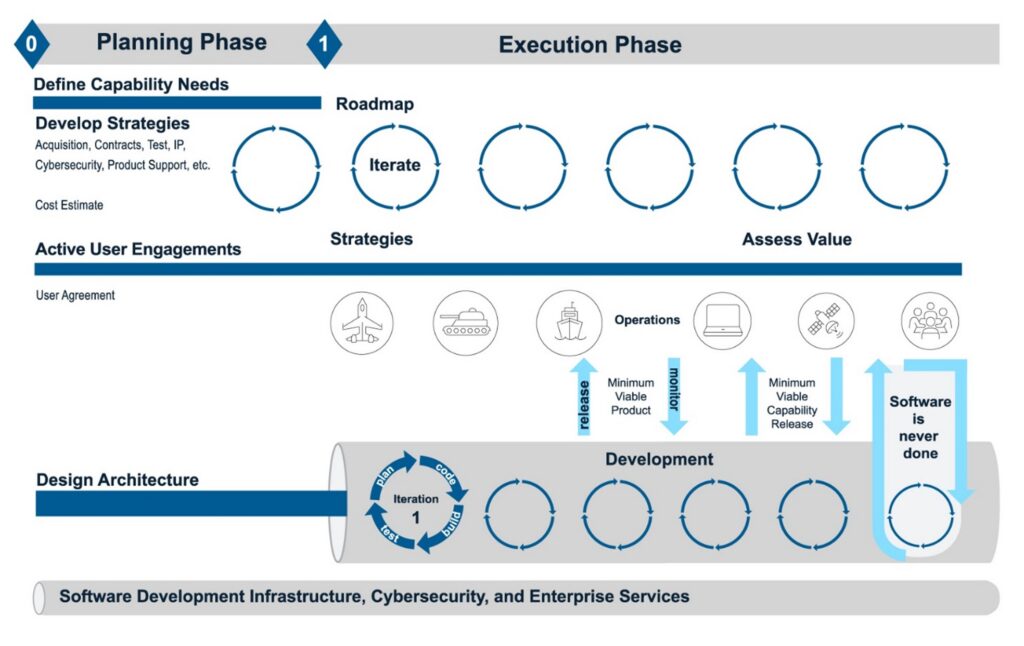
Purpose of the Image
This image illustrates the Software Acquisition lifecycle used by the U.S. Department of War. It shows how software capabilities progress from planning to iterative execution, emphasizing continuous user engagement, incremental delivery, and ongoing operations.
Overall Layout and Reading Order
- The diagram is read left to right, then top to bottom.
- It is divided horizontally into two primary regions:
- Planning Phase (top)
- Execution Phase (top, continuing to the right and downward)
- Supporting activities and infrastructure are shown beneath these phases.
- Circular arrows represent iteration and continuous improvement.
Top-Level Phases
Planning Phase
- Located at the top left.
- Marked with a label indicating Planning Phase.
- Represents activities that define needs, strategy, and direction prior to development.
Execution Phase
- Located at the top center and extending to the right.
- Marked with a label indicating Execution Phase.
- Represents iterative development, delivery, and assessment of software.
Planning Phase Activities
Define Capability Needs
- Identifies what capability is required.
- Appears as the first activity in the Planning Phase.
Develop Strategies
- Includes strategy areas such as:
- Acquisition
- Contracts
- Test
- Cybersecurity
- Product Support
- Also includes cost estimation.
- Activities feed into a roadmap.
Roadmap and Iteration
- A circular label reading “Iterate” appears, indicating planning is revisited repeatedly.
- Iteration shows planning is not a one-time activity.
Execution Phase Activities
Iterative Execution Cycles
- Multiple circular symbols appear in sequence.
- These represent repeating development and delivery cycles.
- Execution is shown as continuous rather than linear.
Assess Value
- Appears toward the right side of the Execution Phase.
- Indicates that outcomes are evaluated regularly to determine value delivered.
Active User Engagements
- A horizontal section below the Planning and Execution Phases.
- Labeled Active User Engagements.
- Indicates continuous involvement of users throughout development.
Icons represent operational users, such as:
- Air
- Ground
- Maritime
- Operations staff
- Technical or enterprise users
(The icons indicate variety of user communities without relying on color or imagery alone.)
Development and Delivery
Design Architecture
- Appears below Active User Engagements.
- Indicates architectural design as a foundational activity.
Development
- A long horizontal section labeled Development.
- Contains repeated circular arrows showing iterative development cycles.
- Includes an inner loop labeled Iteration 1, emphasizing incremental progress.
Incremental Releases
- Vertical arrows point upward from Development to Operations:
- Minimum Viable Product
- Minimum Viable Capability Release
- These labels indicate usable capabilities are delivered early and often.
Continuous Operations
- A vertical label states “Software is never done.”
- Reinforces that software development and improvement are ongoing throughout operations.
Supporting Infrastructure
Software Development Infrastructure, Cybersecurity, and Enterprise Services
- A horizontal bar at the bottom of the diagram.
- Indicates foundational services that support all phases of software acquisition.
- Applies continuously across planning, development, execution, and operations.
Key Concepts Communicated by the Diagram
- Planning and execution are iterative and continuous
- Users are engaged throughout the lifecycle
- Software is delivered incrementally
- Value is assessed repeatedly
- Operations begin early and continue indefinitely
- Cybersecurity and infrastructure underpin all activities
Source: DAU.com
Software acquisition process
There are two paths within the software acquisition pathway.
Applications Path
- Rapid development and deployment of software on commercial or modified hardware.
- Supports cloud‑based solutions and commercially available platforms.
Embedded Software Path
- Rapid development and insertion of upgrades to software embedded in weapon systems or military‑unique hardware.
- Focuses on continuous improvement and rapid iteration.
Planning Phase
- Defines technical approach, schedule, user engagement model, and contracting strategy.
- Establishes DevSecOps environment and initial software requirements.
- Develops the Software Acquisition Strategy (SAS) covering:
- Incremental capability delivery
- Integrated testing and cybersecurity
- User feedback processes
Execution Phase
- Conducts iterative, incremental software development.
- Requires delivery of operational capability within one year of initial funding.
- Provides frequent updates and continuous improvement.
Deployment Decisions
- Occur when software increments meet performance, cybersecurity, and operational criteria.
- Authorize release of new or updated software to users.
Sustainment
- Begins as the system matures or development slows.
- Includes maintenance, cybersecurity patching, capability updates, infrastructure support, and user support operations.
Defense Business Systems
This Defense Business Systems pathway applies for business capabilities and their supporting business systems, including those with “as-a-service” solutions (i.e. financial, logistics, planning and budgeting, installations management, human resources management and training and readiness systems).

Purpose of the Image
This image illustrates the Defense Business Systems acquisition pathway, specifically the Business Capability Acquisition Cycle, showing how business systems progress from identifying a need through deployment and long-term support, with formal decision checkpoints throughout.
Overall Layout and Reading Order
- The diagram is read left to right.
- It shows one linear lifecycle composed of several distinct phases.
- Decision points appear above the phases.
- A labeled bracket beneath the phases identifies the overall cycle.
Acquisition Pathway Description
Defense Business Systems
Description:
This pathway is used for acquiring and managing business systems, such as financial, logistics, or human resources systems, rather than weapon systems.
Business Capability Acquisition Cycle
The entire pathway is labeled “Business Capability Acquisition Cycle”, shown beneath the phases as a unifying lifecycle.
Phase 1: Capability Need Identification
- First phase on the left.
- Labeled “Capability Need Identification.”
- Purpose: Identify and validate a business capability gap or need.
Decision Checkpoint:
- An ATP (Authority to Proceed) milestone appears above this phase.
Phase 2: Solution Analysis
- Located to the right of Capability Need Identification.
- Labeled “Solution Analysis.”
- Purpose: Analyze alternative solutions to meet the identified business need.
Decision Checkpoint:
- An ATP milestone appears above this phase.
Phase 3: Functional Requirements and Acquisition Planning
- Positioned after Solution Analysis.
- Labeled “Functional Requirements and Acquisition Planning.”
- Purpose:
- Define functional requirements
- Plan how the solution will be acquired
Decision Checkpoint:
- An ATP milestone appears above this phase.
Phase 4: Acquisition, Testing, and Deployment
- Located to the right of Functional Requirements and Acquisition Planning.
- Labeled “Acquisition, Testing, and Deployment.”
- Purpose:
- Acquire the solution
- Test functionality
- Deploy the system for use
Decision Checkpoint:
- An ATP milestone appears above this phase.
Phase 5: Capability Support
- Final phase on the right.
- Labeled “Capability Support.”
- Purpose: Provide ongoing support, maintenance, and updates for the business system after deployment.
Key Structural and Governance Elements
Authority to Proceed (ATP)
- Multiple ATP markers appear above the phases.
- Each ATP represents a formal approval gate required before progressing to the next phase.
- ATPs reinforce governance and oversight throughout the lifecycle.
Source: DAU.com
Defense business systems process
Capability Need Identification
- Program teams define the business need or problem to be solved.
- Establishes the purpose and expected outcomes of the new system or capability.
Solution Analysis
- Assess market and business environment for potential solutions.
- Prioritize existing COTS or GOTS options requiring minimal customization.
- Conduct market research, business process analysis, and gap assessments.
Functional Requirements & Acquisition Planning
- Translate the selected solution into operational and technical requirements.
- Define scope of work.
- Prepare acquisition planning documents and necessary artifacts.
Acquisition, Testing & Deployment
- Conduct solicitation (if needed), source selection, and contract award.
- Perform system development or configuration.
- Test system to verify functional and performance requirements.
- Deploy the system to users after successful testing.
Capability Support
- Manage system upgrades and performance monitoring.
- Ensure continued compliance with business rules and regulatory requirements.
Acquisition of Services
The Acquisition of Services pathway governs U.S. DoW purchases of contracted services (e.g., maintenance, IT, professional support) valued above the Simplified Acquisition Threshold (~$350,000).
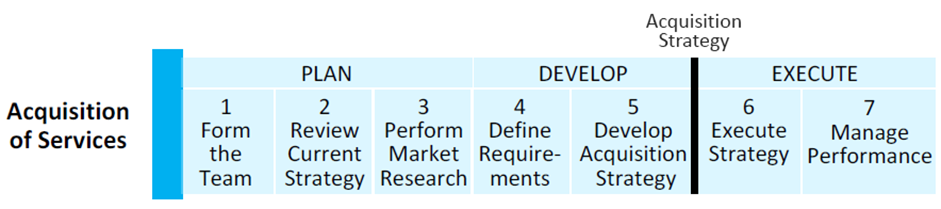
Purpose of the Image
This image illustrates the Acquisition of Services process used by the U.S. Department of War. It presents a seven-step lifecycle, organized into three higher-level phases—Plan, Develop, and Execute—that guide how services are acquired and managed from initial planning through performance management.
Overall Layout and Reading Order
- The diagram is read left to right.
- It shows one linear lifecycle with numbered steps.
- Steps are grouped under three labeled phases across the top.
- The lifecycle emphasizes progression and accountability.
Acquisition Pathway Description
Acquisition of Services
Description:
This pathway applies when the Department of Defense acquires services rather than products or systems, such as professional services, support services, or contracted labor.
High-Level Phases
Phase Group 1: Plan
- Located on the left side of the diagram.
- Covers preparation and analytical activities before committing to a strategy.
Phase Group 2: Develop
- Located in the middle of the diagram.
- Focuses on defining requirements and developing the acquisition approach.
Phase Group 3: Execute
- Located on the right side of the diagram.
- Covers carrying out the strategy and managing outcomes.
Detailed Lifecycle Steps
Step 1: Form the Team
- First step in the Plan phase.
- Purpose: Assemble the acquisition team with appropriate skills and roles.
Step 2: Review Current Strategy
- Second step in the Plan phase.
- Purpose: Review existing strategies, lessons learned, and organizational goals relevant to the service being acquired.
Step 3: Perform Market Research
- Final step in the Plan phase.
- Purpose: Analyze the market to understand available service providers, pricing, and industry capabilities.
Step 4: Define Requirements
- First step in the Develop phase.
- Purpose: Clearly define service requirements, outcomes, and performance expectations.
Step 5: Develop Acquisition Strategy
- Second step in the Develop phase.
- Purpose: Create the acquisition strategy based on requirements and market research.
- The label “Acquisition Strategy” appears above this step, emphasizing its importance.
Step 6: Execute Strategy
- First step in the Execute phase.
- Purpose: Implement the acquisition strategy, including contracting and service delivery.
Step 7: Manage Performance
- Final step in the Execute phase.
- Purpose: Monitor contractor performance, manage outcomes, and ensure services meet requirements over time.
Structural and Visual Notes
- Each step is numbered sequentially from 1 through 7.
- Steps are displayed as equal visual blocks to indicate their importance.
- Progression is unidirectional, with no loops or branching paths.
- Grouping under Plan, Develop, and Execute conveys logical organization without reliance on color alone.
Services acquisition process
In the Planning Phase, the organization identifies the specific services needed, determines the performance outcomes desired, and conducts essential market research and requirements definition work.
During the Develop Phase, the focus shifts to preparing the documentation and solicitation strategy necessary to procure the services. This includes drafting the performance work statement (PWS) or statement of objectives (SOO), integrating measurable performance standards, assessing contracting strategies, and ensuring compliance with applicable regulations and socio-economic goals.
Finally, the Execute Phase encompasses awarding the contract, administering performance, and closing out the acquisition. In this phase, the government monitors contractor performance against the PWS, applies earned value or other performance measurement tools as appropriate, manages changes to scope or contract requirements, ensures quality assurance and compliance, and handles disputes or corrective actions as needed.
Post-award activities also include performance reporting, conducting lessons-learned reviews, and transitioning services when contracts expire or requirements evolve.